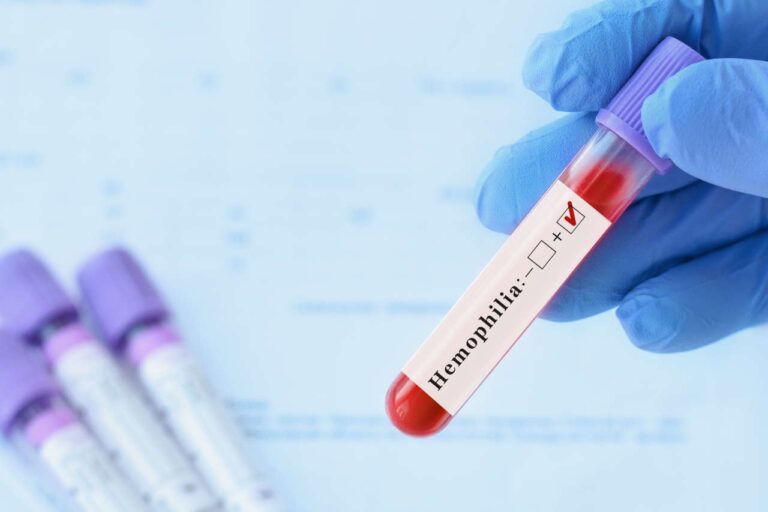




El reconocimiento precoz de los síntomas de la hemofilia en niños y el tratamiento oportuno son esenciales para prevenir discapacidades de por vida. Los síntomas pueden variar desde cortes menores hasta hemorragias internas potencialmente mortales.
Obtenga asistencia financiera
¿Qué es la hemofilia?
Hemofilia Es un trastorno hemorrágico que impide que la sangre coagule con normalidad. Los niños que nacen con esta afección tienen poco o ningún factor de coagulación en la sangre. Un factor de coagulación es una proteína presente en la sangre que ayuda a la coagulación. Por consiguiente, los niños tienen mayor probabilidad de sufrir hemorragias graves y otras complicaciones.
Los dos tipos principales son:
- Hemofilia ALos niños carecen del factor de coagulación VIII o tienen una cantidad insuficiente.
- Hemofilia BLos niños carecen del factor de coagulación IX o tienen una cantidad insuficiente.
Dependiendo de los niveles del factor de coagulación, la hemofilia puede ser [1]:
- Leve: 5% a 40% de niveles de factor de coagulación
- Moderado: 1% a 4% de niveles de factor de coagulación
- Severo: Menos de 1% de niveles de factor de coagulación
Aunque incurable, la hemofilia es tratable. Con los tratamientos adecuados, los niños con hemofilia pueden llevar una vida sana.
Cómo reconocer los síntomas de la hemofilia en niños
Los síntomas de la hemofilia en los niños pueden variar según la gravedad de la enfermedad.
Muchos padres notan los primeros síntomas de la hemofilia poco después de que su bebé empieza a gatear o caminar. En esta etapa, los síntomas pueden incluir moretones grandes, articulaciones hinchadas y calientes, y que el bebé evite usar el brazo o la pierna afectados. Asimismo, algunos padres pueden notar sangrado prolongado durante la vacunación, la circuncisión o las revisiones dentales rutinarias.
En los casos leves, es posible que no aparezcan síntomas evidentes a menos que se produzca una hemorragia grave tras una cirugía o una lesión.
La hemofilia puede causar hemorragias externas e internas. Los signos de hemorragia externa pueden incluir:
- Sangrado en la boca del niño debido a un corte, una mordedura o la pérdida de un diente de leche.
- Sangrado de una herida que se detiene por un corto período y luego continúa.
- Sangrado inusual por un corte menor
- Hemorragias nasales sin causa aparente.
- Menstruaciones abundantes en las niñas
El sangrado interno se refiere al sangrado en los órganos y músculos. Cuando se produce sangrado en la vejiga o los riñones, puede causar sangre en la orina (que puede ser roja o marrón). De igual manera, el sangrado en el tracto digestivo puede causar heces negras y alquitranadas o mezcladas con sangre roja brillante. Los hematomas grandes pueden indicar sangrado en músculos grandes.
Sangrado en una articulación
Sangrado articular (hemartrosisEl sangrado articular es frecuente en niños con hemofilia. Las articulaciones más afectadas suelen ser las rodillas, los tobillos y los codos. Puede producirse sangrado articular sin una lesión grave. Si un niño con sangrado articular no recibe tratamiento inmediato, la articulación afectada puede sufrir daños permanentes.
Un bebé con sangrado articular puede estar irritable sin razón aparente. Los niños mayores pueden describir una sensación de hormigueo o un "aura" en la articulación antes de que aparezcan los signos externos. Otros signos y síntomas pueden incluir:
- Articulaciones rígidas, dolorosas, hinchadas y calientes.
- Incapacidad para mover o estirar un brazo o una pierna.
Hable con un especialista en asistencia para copagos
Hemorragia cerebral
La hemorragia cerebral es la complicación más grave de la hemofilia. Es más frecuente en niños menores de dos años. Cabe destacar que es la principal causa de muerte y discapacidad en niños con hemofilia.
Los signos de hemorragia cerebral incluyen:
- convulsiones
- vómitos constantes
- Visión doble
- Dolor o rigidez en el cuello
- Dolores de cabeza prolongados
- Somnolencia
- Cambios de comportamiento
- Debilidad repentina en brazos o piernas
- Problemas de equilibrio y coordinación
Si su hijo presenta alguno de estos síntomas, especialmente después de un golpe en la cabeza, busque atención médica de urgencia.
Síntomas de la hemofilia en niños: ¿Cuándo consultar a un profesional de la salud?
Busque atención médica inmediata si su hijo:
- Tiene una lesión grave
- Se desmaya
- Vómitos tras un golpe en la cabeza
- Tiene convulsiones
¿Afecta la hemofilia al calendario de vacunación en niños con hemofilia?
Los niños con hemofilia deben recibir todas las vacunas necesarias según el calendario de vacunación, independientemente de la gravedad de la enfermedad. El médico de su hijo podría administrarle una vacuna mediante inyección subcutánea (debajo de la piel) en lugar de inyectarla en el tejido muscular (intramuscular).
REFERENCIAS:
- Bertamino, Marta et al. “Atención de la hemofilia en la edad pediátrica”. Revista de medicina clínica, vol. 6, n.º 54, 19 de mayo de 2017, doi:10.3390/jcm6050054