



Symptoms of Guillain-Barre syndrome vary widely from person to person. Some people develop mild weakness that lasts only a few weeks, while others may experience severe muscle weakness or paralysis.
Get IVIG Copay Assistance
Speak to a SpecialistSymptoms usually worsen for up to 4 weeks before reaching their peak. Recovery often begins within days to several weeks after symptoms peak, and improvement may continue for several months. About 20% of people continue to experience some degree of disability for more than a year, such as needing walking aids. In people with severe weakness, recovery may continue gradually for two years or longer.
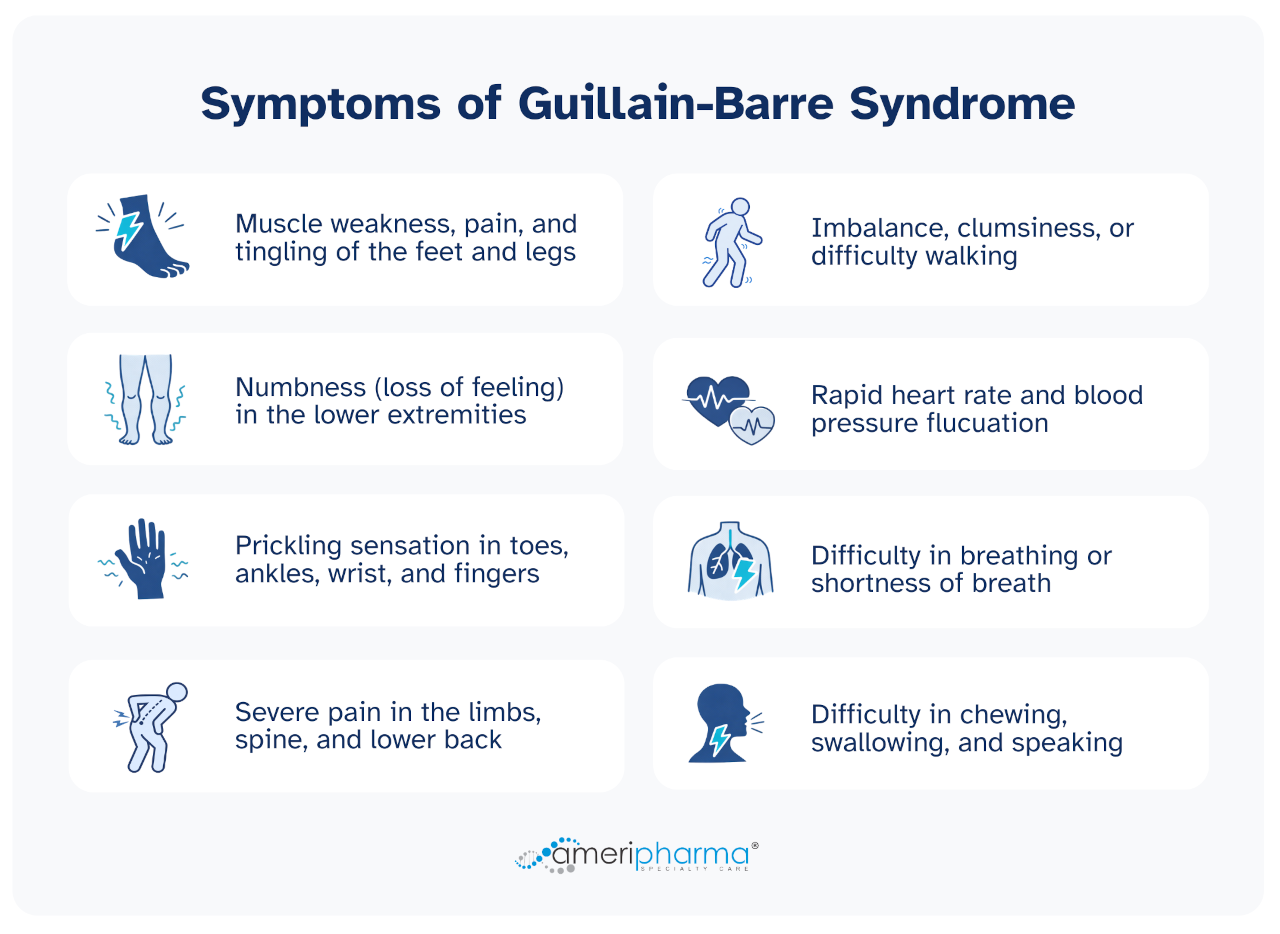
Early symptoms of Guillain-Barre syndrome may include the following:
- Weakness and tingling that usually begin in the feet and legs before gradually spreading to the arms and upper body, often affecting both sides of the body equally. A pins-and-needles sensation may be felt in the toes, ankles, wrists, and fingers.
- Numbness (reduced sensation) in the feet and legs.
- Loss or reduction of reflexes, which is a common feature of Guillain-Barre syndrome.
- Difficulty with balance or coordination.
- Double vision or difficulty moving the eyes.
- Difficulty in chewing, swallowing, and speaking.
Severe symptoms of GBS include:
- Difficulty breathing or shortness of breath
- Tingling or weakness that rapidly spreads to the arms, face, or upper body
- Weakness or difficulty moving the facial muscles
- Difficulty walking
- Severe lower back pain or muscle pain
- Difficulty swallowing, including choking on saliva or liquids
- Rapid or irregular heartbeat
- Fluctuations in blood pressure
- Problems with bladder control or bowel function
- Extreme pain
- Paralysis
Can IVIG help?
Free IVIG Treatment InfoSeek medical attention immediately if you experience rapidly worsening weakness, difficulty breathing, trouble swallowing, or any of the symptoms listed above. Early diagnosis and treatment can reduce the risk of serious complications.
Complications and life-threatening symptoms of Guillain-Barre syndrome may include:
- Long-term or full-body paralysis
- Infections, which can sometimes progress to sepsis in severely ill patients
- Cardiac arrest
- Pneumonia
- Acute respiratory distress syndrome
- Deep vein thrombosis (DVT) or pulmonary embolism (blood clots) due to prolonged immobility
- Recurrence of symptoms in a small number of patients
Conclusion
Guillain-Barre syndrome is a serious but treatable neurological disorder, and most people recover fully or nearly fully with appropriate medical care. Recovery may take several months and, in severe cases, can continue for 2 years or longer. However, if symptoms worsen rapidly, spread to other parts of the body, or affect breathing or swallowing, the condition can become life-threatening. Prompt medical evaluation and treatment can reduce the risk of complications such as paralysis, pneumonia, blood clots, heart rhythm abnormalities, and respiratory failure.